

















Jin Ho Verdonschot
Justice sector adviser/researcher HiiL Innovating Justice - TISCO, Tilburg Law School
Both parties have their ideas about what is fair. Others nearby or in other countries will have had similar problems. Use the criteria and schedules used in settlements and formulas set by courts to avoid a deadlock.
The Sharing Rules project is aimed at making the going rates of justice transparent. Most disputes have distributive issues such as determining an amount of child support, compensation to be paid or properties to be divided. All these questions come down to: who gets how much, has to pay what, has to do or stop doing which things? Imagine being able to easily predict outcomes for these issues on the basis of clear formulas, guidelines, tables, etc. that describe what reasonable and fair outcomes are. This is the essence of the Microjustice Initiative Sharing Rules project.
Across the board benefits
Every actor within the dispute resolution system can benefit from such concrete, transparent sharing rules that are easily accessible. Judicial workloads will decrease when legal practitioners can rely on a predeterminded rule that applies to most cases. Lawyers will be better equipped to support their clients, when they have clear objective guidelines they can use to give legal advice and it will be easier for people to settle cases out of court fairly. This obviously is not linked to a specific jurisdiction.
Part of the project is to build an online platform where people can get and bring information about standard outcomes and ways in which fair outcomes can be determined. The platform grows to become a database of sharing rules for the most common distributive issues and has the potential to become a global repository for these: a Civil Code 2.0.
Overcoming scepticism
The idea of sharing rules deviates from the usual approach in legal decision-making. Lawyers are trained to focus on all the circumstances of a case and, more or less intuitively, evaluate their weight and relevance. They are not really used to think in terms of generalisations and concrete norms that can be applied generally.
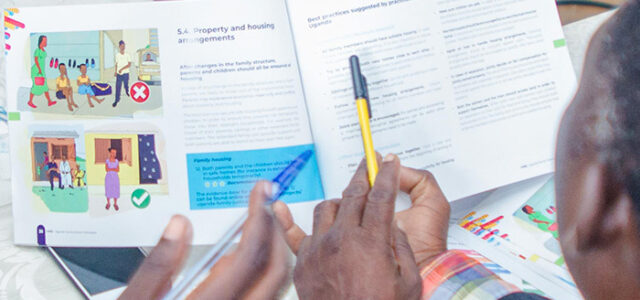
In order to build proof of concept, the Sharing Rules project developed a spin off in Nairobi, Kenya, focussing on the people living in Kiberia. The formal legal system is not a part of their reality. The paralegals, lawyers, chiefs and other dispute resolution professionals who are active there, expressed a big need for practical legal information. Together with local justice delivery organisations, the Microjustice Kenya project was developed.
1. Can you briefly describe the innovation, the problem it tries to solve and why it is necessary?
Imagine you could easily predict the outcome of your conflict in distributive terms: who should get or pay how much, has to refrain from doing what or has to do what? That is what the sharing rules project is about: making transparent the going rates of justice for the most common distributive issues of conflicts (child support, alimony, compensation in case of eviction, etc.)
Sharing rules can be described as legal or social norms that indicate what a fair share of value, damages or tasks is. It can be formulas, schedules, guidelines, etc. that provide concrete and direct information to disputants about how they can share. Some good examples of sharing rules are formulas for calculating severance payment that can be found in many countries, grids that are used for determining compensation in case of personal injury. Some countries have simple tables with percentages to determine the amount of child support to be paid.
Sharing rules are not primarily valuable because of an authoritative or normative element. They rather reflect and suggest how other people share fairly. In a way, it is similar to pricing information in other bargaining situations. When the average price of a used car you want to buy is transparent to both parties, it will be easier to come to a reasonable deal than when reasonable prices are unknown. The effects of sharing rules on disputes will be similar.
Obviously, this goes beyond information from legal codes and case law. Rather, dispute resolution professionals (like legal facilitators, lawyers, judges, academics, people who were involved in a dispute and shared according to a certain rule). Goal is to attract these people to share their expertise on sharing rules. Or to develop easily applicable methodologies for this, so others can make this transparent. And to make this evidence based, so gradually, a better picture is created of how people actually share and could share. You could call this drafting a Civil Code 2.0: not rules promulgated by legislators or Supreme Courts but suggested by peers and proven to be effective for fair sharing.
2. What makes your innovation unique?
People who have to divide value, tasks or damages do not typically have the going rates of justice at their disposal. As indicated, sometimes, good sharing rules are developed. By commissions of judges and academics, through self-regulatory bodies, or individuals. However, no systematic efforts were or are made to do this: providing concrete sharing rules that are easily accessible and made transparent. We make the legal and social norms that are already existing explicit and build a platform so people and organizations can share their expertise and experiences in this respect.
3. What triggered the development of the innovation?
There are very clear indications from practice ánd research that there is a need for transparency of ways to share fairly, a frame of reference for negotiating about distributive issues. For understandable reasons, systematic efforts to realize this do not emerge spontaneously within the market. Hence, a katalyst seem to be needed for this. We aim to be just that.
4. Which persons and organisations were involved in the development and what role did they play?
Maurits Barendrecht already focused on development and necessity of concrete legal norms in his PhD research. Later, within TISCO, this research became more informed by others disciplines as well (cognitive psychology, negotiation theory, conflict studies, microeconomics). I build on this research and added to it and together we further developed the idea of a Civil Code 2.0, i.e. an online platform for facilitating and stimulating transparency of sharing rules.
5. What kind of resistance have you encountered and how have you overcome it?
Lawyers are trained to focus on all the circumstances of a case and evaluate their relevance. We are not really used to think it terms of generalizations and concrete norms that can be applied generally. The bottom line is that the idea of sharing rules does not connect to the way we think.
What you often see in case law, or legal texts is that we find it difficult to explicate what the concrete weight of the circumstances were and which one were deemed to be decisive in what way. A sharing rule will contain the main, decisive principle and concrete weights that can serve as clear indications.
The funny thing is that when sharing rules are available, we are pretty much inclined to accept and use them. Take the abundant formulas for severance payment for example, or norms for calculating alimony. However, scepticism remains. This can be overcome, I think, by showing that sharing rules work. To create successes so it cannot be ignored.
6. How did you make the goals realistic and attainable, and at what time will which quick wins be available?
Deliverables are 80 sharing rules made available on an online platform and the development of a business model. We narrowed the project down to 80 sharing rules from 4 locations in order to quantify it and keep it realistic. The realism of the deliverables is further based on several observations.
An inventory of the successful online initiatives in the area of “crowdsourced” development and sharing of highly valuable information, to us is a clear indication of the level of realism of our effort. More and more lawyers, especially of the younger generation seem to have embraced social media and the thinking that is associated with it: transparency, value sharing, openness.
The scope of the goal, however, is broader than the deliverables, of course. As a goal, we can state that we want to help people to more effectively and less burdensome deal with their conflicts against less costs. There are some very clear and solid indications that the impact of sharing rules on dispute resolution for people can be very big. Several strands of research from (experimental and otherwise empirical) cognitive and social psychology, negotiation theory and legal scholarship point in that direction. As well cases from practice.
Quick wins are the sharing rules which we already have collected and developed. The first real field project is running soon in Nairobi. Here sharing rules are being developed and systematically evaluated, a website is being build and we have one or two partners implementing them into practice. The idea of sharing rules is put to the test of reality. We will measure impact and effects on people’s capacity to solve their conflicts, or to help other people solve their conflicts. The first data become available in the second half of 2011.
7. Will the innovation have an effect on other organisations in the chain and if that is the case, how will it affect them?
Every actor within the dispute resolution system can benefit from the sharing rules. The workload of the judiciary will decrease if they do not have to invent a clear norm every case but can rely on a predetermined sharing rule that applies to most of the cases, lawyers are better able to support their clients and entry a settlement when they have some clear objective guidelines they can use. It probably also becomes much easier for people to settle among each other when the going rates of justice are transparent to all.
8. How was the development funded and what were reasons for the financing organisation?
As one of the subprojects of the Innovative Rule of Law Initiative (IRI) the Sharing Rules project is funded by the two grantors of IRI: the Dutch Ministry of Economic Affairs and the municipality of The Hague and Microjustice’s own contribution.
Reasons for financing are further development of The Hague as a centre of excellence where knowledge and innovative products and services are being developed in order to strengthen the rule of law. Sharing Rules are one of the innovative products and services.
In addition to this, we are seeking to further intensivate the cooperation with Oxfam Novib on this issue. We did a research project including diagnosis of the situation with regards to legal information in Mali, Azerbaijan, Bangladesh, Rwanda and Egypt and found that there is huge potential and also an experessed need for sharing rules among legal aid NGOs working there. At this stage, we are defining a project that also focuses on sharing rules.
9. Can you name 3 to 5 characteristics of the innovation that are most essential to make it work?
- Sharing rules probably best can be presented in a neutral environment. I think it is important that they are not presented by us as thé way to go, or qualified as bad by us. We should focus on make them transparent from a neutral perspective and enable others to qualify them as fair or less fair.
- Justice users need to be able to easily find us; the sharing rules need to be accessible at the time that justice users need them;
- We need to find a large group of innovation minded lawyers that are willing to cooperate with us and give it a boost;
- We need to actively focus on creating successes and show these successes to the world around us;
10. How do you measure whether it is a successful innovation?
We need to keep track on the justice users and the people who support these clients. These are the most valuable sources of information about the success of the project. Do they actually find sharing rules useful? Did they help them in their efforts? We will build on user feedback (including people who face a legal problem ánd the people that support them) to measure the success of the innovation, for instance by conducting surveys, organizing expert meetings and focus groups.
11. How many people or organisations benefit from this innovation now?
As we are still in the phase of development there are no real beneficiaries at the moment yet.
However, in a previous project of TISCO regarding the divorce plan sharing rules were already involved. The divorce plan has been implemented and is available online. I am not aware of the number of visitors of this website.
12. How many people or organisations could potentially benefit from it now or in the future? (scaling-up)
Virtually everyone.
Realistically:
- justice users
- lawyers, paralegals, mediators and other people in the business of dispute resolution
- judges and other neutrals
More generally speaking, we could say that every person will experience one or two impactful legal problems in their lives. People get divorced, face difficulties with an inheritance, get fired, encounters a difficult neighbor or landlord. In these situations, they can use information that tells them what a normal, fair and reasonable outcome is and hence benefit from transparency of sharing rules.
13. Can you quantify the financial benefits? (Cost savings, additional income or otherwise)
The business model will cover / lead to financial sustainability, but still needs to be identified. We follow the state of the art adage in this respect: development of the business model follows the development of the business and choose to develop it incrementally with an open mind.
Indirectly speaking, sharing rules will lead to financial benefits as they provide cheaper access to (indications of) just solutions. If the going rates of justice are transparent to all, it becomes easier to settle. Think back to the analogy of pricing information. If the price of a used car is known to both seller and buyer and both are aware of the fact that both have this information at their disposal, they will easier agree on a reasonable price. Hence, sharing rules will increase the number of fair settlements.
In addition, it might help to reduce the lengthiness of procedures. Most court cases are not really exotic but rather straightforward, perhaps even bulky. If judges can rely on sharing rules for their decision in these cases, they need less time.
14. Is the innovation financially viable and sustainable and if yes, how?
Yes, one major investment to get the idea started is the online platform and these costs are covered. The running costs once the website is live are not big. The idea is also that people (academics, practitioners) will co-develop the knowledge online.
Furthermore, other organizations like legal aid organizations, or even law firms and courts might want to buy in.
15. Can or will the innovation be used internationally and how do you overcome cultural differences?
Yes. The platform can be used to share sharing rules form all countries and regions. In addition to that, as I stated earlier, normativity is not key. Rather the descriptiveness of solutions that worked for others is. This, obviously, is not bound to jurisdictions or countries.
On good example stems from Mali. Customary law plays an important role in many rural areas. Deme So, on of the leading legal aid NGOs in Mali trained the village elder, who usual is the one dealing with conflicts in his community, in using some basic legal norms. They did not tell him that he should use these from now on or impose them on him in any way. All they said was that this is
how most people deal with conflicts and suggested him to keep this in mind. Practice showed that this village elder was very much inclined to let his decisions be informed by these legal norms. He did not follow them blindly, but typically found middle ground solutions using both the customary norms and the legal norms.
16. What lessons did you learn along the way that could be useful to others?
- Regarding cooperation with other ‘actors’: focus on the (minority of) people who are open minded and willing to innovate, rather than focusing on the skeptical (majority of) people. Of course, you have to be open for every kind of criticism, but I found that if you focus on dealing with all of this and try to mitigate every risk identified up front makes one numb. The lesson I learned is to have all these in mind and then in practice try to find ways to deal with them, rather than analytically try to do so. Also, do not remodel every aspect of the concept in order to achieve general agreement, but focus at the fewer people who are convinced of the concept. Don’t let criticism and skepticism completely determine your agenda. However, criticism on the practical level is absolutely useful (compared to the criticism on the more fundamental level).
It also gives you more energy to start with what you want and feel confident will work.
On the other hand, try to find ways to get the skeptical (majority of) people involved as well;
- Start creating successes and prove in practice that it works, so other will follow;
- When talking to potential partners communicate on their level and focus on concrete practical solutions rather than talking about theoretical background;
- It is not a bad thing to make mistakes. It is important to feel safe to make mistakes. You can learn from it and should be open about it.

.jpg)
How to establish a reasonable amount of child support?
Smart ways to deliver the legal information people really need
.png)